
The Best Way to Use Money
For the past couple of years, my theme of thought has been “What should I spend my money on?”
Questions like “Aren't you buying a luxury apartment?” “Aren't you buying a vacation home?” “What about a Lamborghini?” “A Rolex?” are often asked.
I am not particularly interested in luxury cars or brand-name items, and I haven’t made any notable high purchases. (I already bought my own home ten years ago.)
The only things I have purchased for a significant amount are the following, and excluding loan repayments, I think it totals about 3 million yen.
- Full repayment of my home loan
- Full repayment of student loans
- Garden renovation
- Cat
- Macbook Pro
- Dyson vacuum cleaner for the second floor
- Dyson hairdryer
- DoCoMo Hikari 10GB
However, I’ve somewhat felt that rather than being indecisive about how to spend, I believe this is the correct way to think.
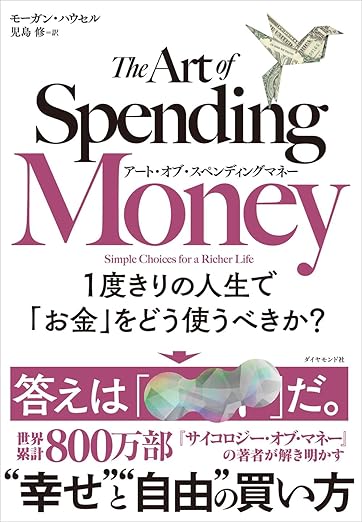
Just when I wanted to articulate my actions, I came across the wonderful book “The Art of Spending Money,” which indicates how one should use money in this one-time life.
How to Use Money
According to this book, there are two ways to use money.
The first is as a tool for leading a better life, and the second is as a measure to gauge one’s status in comparison to others.
Luxury cars and brand-name items are precisely the latter. What I have purchased so far completely falls under the former. The essence of the book is to say: let’s use money not for status, but to make ourselves and our loved ones happy.
Instead of always desiring what we don’t have, we must be thankful for what is in front of us. This is an extremely important attitude when contemplating money and happiness.
There is a Stoic saying that goes: “Not needing wealth is more valuable than wealth itself.”
The key point is that elements that truly make a person happy, such as “family,” “friends,” “health,” “a sense of purpose,” and “a clear mind,” cannot be bought with money and must be acquired on one’s own.
Respect and Jealousy
If you display the proof of your success to others, you may gain attention and admiration. However, in reality, the emotions others feel are often jealousy.
Benjamin Franklin, known as a Founding Father of the United States, said, “One of the secrets of life is realizing that 'people are easier to respect when they aren’t envied.'”
It is difficult to distinguish between respect and jealousy. Those who adorn themselves with flashy items often mistakenly believe they are respected when in fact they are just envied.
This is particularly true for those who have become wealthy by gathering praise and support from others. When admiration turns into envy, public support diminishes, and scrutiny towards failures increases.
If you are trying to climb the social ladder while seeking attention, keep in mind the following:
Am I making others envious in the process?
This could be a downside that is overlooked in the blind pursuit of higher status.
One must also be cautious of feelings of jealousy within oneself.
Being jealous means comparing oneself to others.
The writer Lawrence Yow stated:
“Jealousy is inversely correlated with self-exploration. In other words, the less you understand yourself, the more you use others as a benchmark for assessing your worth. As your understanding of yourself deepens, you seek less from others, and jealousy begins to fade.”
What Should Money Be Spent On?
The book states that one should spend money on “things that aren’t necessary but add color to life.”
For example, an occasional extravagant meal, an annual family vacation, or high-quality clothing bought from time to time. If you have to give these up for some reason, it may feel a bit tough, but it’s not particularly problematic.
The important thing is to consciously choose while enjoying, without becoming attached. Only then will money become a helpful tool and not a master to serve.
What people really desire from money might be the ability to live without constantly thinking about it.
It's about building enough assets to focus on other important things and then stopping living only for thinking about money.
However, this ultimate goal can become fragile when the habit of saving money becomes deeply rooted in one’s identity. If one cannot escape the fixation on money, they tend to believe that the success of life equates to increasing their bank balance, failing to use money wisely even in appropriate situations.
Many people might have unconsciously replaced the goal of “increasing money” itself with the ultimate purpose. If thinking about money was meant to be the ultimate goal, at some stage, one should recognize that they have achieved it.
On the other hand, it is a well-known fact that the more capital you have, the easier it is to grow your assets due to the benefits of compound interest. The environment where having more money helps one to increase their wealth only further promotes this idea.
How to Raise Children
Many wealthy people worry that if they let their children live too luxuriously, their motivation and ambition may diminish.
I also agree on that point. So how should we interact with our children concerning money?
There was a passage in the book:
Children observe what you value. They also know how you waste money. When you come home excited to report to a recipient about your raise and your anxious expression during a layoff, they imprint that on their minds. They know when you envied your neighbor’s new car. They hear you arguing with the recipient about how to spend money. They notice your greedy side as well as your frugal side.
Children observe their parents' actions closely, and by the time they grow up, it greatly influences their own views on money.
I didn't consciously realize it, but I do feel like they are watching. What might be important is not the timing or amount when giving money, but conveying the correct way to use money.
I think to myself that I should use money in a way I won't be ashamed to show my child... but if I do not spend money on what I want to do, that would be meaningless as well.
At the very least, rather than using money as a measure to assess my status with others, it might be good to show how I use it as a tool for leading a better life.
Additionally, I came across this passage that I want to heed:
“Parents are not just responsible for spoiling their children and making them selfish by giving them many things.”
“The cause for this is often parents teaching their children that individuals with a lot of money are superior.”
About Saving
There was an interesting episode regarding saving.
When he asked, “How often do you drink lattes?”, the colleague replied, “Every day.”
“Wow! Have you been drinking a latte every day for the past 30 years since becoming a company employee? That’ll add up to a significant amount. If you drink one latte a day, that’s about $1900 a year. If that money had been invested at an 8% return, you would now have $250,000. That’s enough to buy a Ferrari.” The colleague looked puzzled and asked, “Do you buy lattes?”
The man replied, “No.”
“Then where is your Ferrari?”
In Japan, similar stories that one should refrain from daily tobacco... or coffee are sometimes seen. However, these usually appear in the context of saving, and I think the essence is quite the opposite.
Moreover, while many hesitate to save on daily lattes, they often don’t hesitate to spend on more significant amounts for home appliances or travel. Clearly, saving on larger purchases would be more efficient in terms of saving.
This phenomenon is expressed in the book as “The attention to a problem is inversely proportional to the importance of that problem.”
One reason this happens is that fixating on small expenditures creates a sense of “I’m thinking about how to spend money, taking action, and making progress.” As a result, it becomes easier to ignore the more significant problems.
What is Happiness?
The great psychologist Carl Jung answered the question “What are the fundamental elements that make people happy?” as follows:
- Being healthy both physically and mentally
- Having good personal and intimate relationships such as marriage, family, and friendships
- Being able to appreciate the beauty of art and nature
- Living at a reasonable standard of living and having a satisfying job
- Having a philosophical or religious perspective to cope well with life's ups and downs
Achieving these does not require a large sum of money.
In other words, true happiness is not directly related to money.
Money is something decorative; it’s just right to think of it as adding a little color to the base happiness.
Conclusion
Let’s stop using money to be envied by others. Instead, let’s use it to bring joy to ourselves and our loved ones.
Everyone already possesses things more important than money.
Let’s re-examine what has become ordinary and feel happiness.



- Kazuki Shibata


- microCMS Co-founder CEO / Designer and front-end engineer / Father of 2